Four years shipping end-to-end features and integrations for SaaS and marketplace platforms. Lately that's meant C#/.NET alongside React and Node.js; earlier roles were JavaScript-first. All of it on fully remote, international teams.
Before software: account management and business administration in tourism and hospitality. That's not a detour on my CV. It's the reason I ask why before I ask how.
Next.js · GraphQL · PostgreSQL · Elasticsearch · Azure · AI-assisted development
I spent several years in business administration and account management across tourism and hospitality — including managing a portfolio of 500+ properties at Booking.com, with an MBA in Hospitality and Tourism Management behind it. Then I did an intensive full-stack bootcamp and moved into engineering.
Four years in, that background hasn't faded — it's the part of my work people notice. I default to understanding the "why" behind a feature. I can sit with non-technical stakeholders and leave with a real spec instead of a wish list. And I tend to spot manual work that shouldn't be manual — a good share of what I've shipped is automation that takes something people used to walk through by hand and lets it run on its own.
I now build with agentic loops rather than one-off prompts — giving Cursor and Claude a goal, letting them plan, execute, check their own output and correct it, with me steering and reviewing the result. It's a different skill from writing code alone, and it's changed how much ground I can cover.
Currently building features and integrations at IANS. Open to Full Stack, Frontend and AI engineering roles — including work where software supports the commercial side of a business, which is the intersection I know best.
Commercial work taught me that the feature nobody asked for is the most expensive thing you can ship.
Why I ask questions firstSoft skills are easy to claim, so here's what each one is actually grounded in.
I'm comfortable on both sides of the table — gathering requirements from people who don't think in tickets, then turning them into something a team can build.
Grounded in: years of account management + presenting a live product demo of the React frontend to the whole company at Leal.I've been the person accountable to the client, so I don't treat the end user as an abstraction. I ask who this is for and what breaks for them if we get it wrong.
Grounded in: managing a 500+ property portfolio at Booking.com, supporting their commercial strategies and product adoption.Warmth and collaboration are part of my professional brand, not a nice-to-have. I like unblocking people and I'd rather explain something twice than have someone stay stuck.
Grounded in: teaching assistant for an 18-person cohort at Henry; contributing inside a 6-person engineering team at IANS.I pick things up quickly and I don't wait to be handed a plan. If a process looks like it's costing the team hours, I'll say so — and then go automate it.
Grounded in: taking primary ownership of frontend development shortly after joining Leal; repeatedly turning manual internal processes at IANS into automated flows, and adopting agentic AI workflows ahead of the team.A few of the things I've built at IANS. Most of these went out before AI tooling was part of how anyone worked — every line reasoned through by hand. I've since gone back to several of them with AI in the loop to extend and sharpen what was already there.
A daily automation that reads every client's preferences and sends each person exactly the content they asked for, at the rhythm they chose.
Clients set what they want and how often they want it — real time, daily, twice a week, weekly — plus the topics they care about. A job runs every day, and for each user it checks their chosen frequency, pulls everything published inside that window that their permissions entitle them to, and sends it. Nobody assembles anything; nobody presses send.
I built both halves: the preference center where those choices are made, and the email that comes out of it — grouped by content type, with real titles and summaries, designed to pull people back into the platform rather than just notify them.
The email HTML is generated server-side from our C# project and had to render correctly across desktop clients and webmail alike — a constraint closer to 1999 than to modern CSS. I validated it by hand, client by client, until it held. It held well enough that when the company built its next content email, my template became the model for it.
The digest on its own now drives about as much portal traffic as the entire previous email program did — and it seeded a family of three.
Took a publishing chain that crossed three systems by hand and made it run on its own.
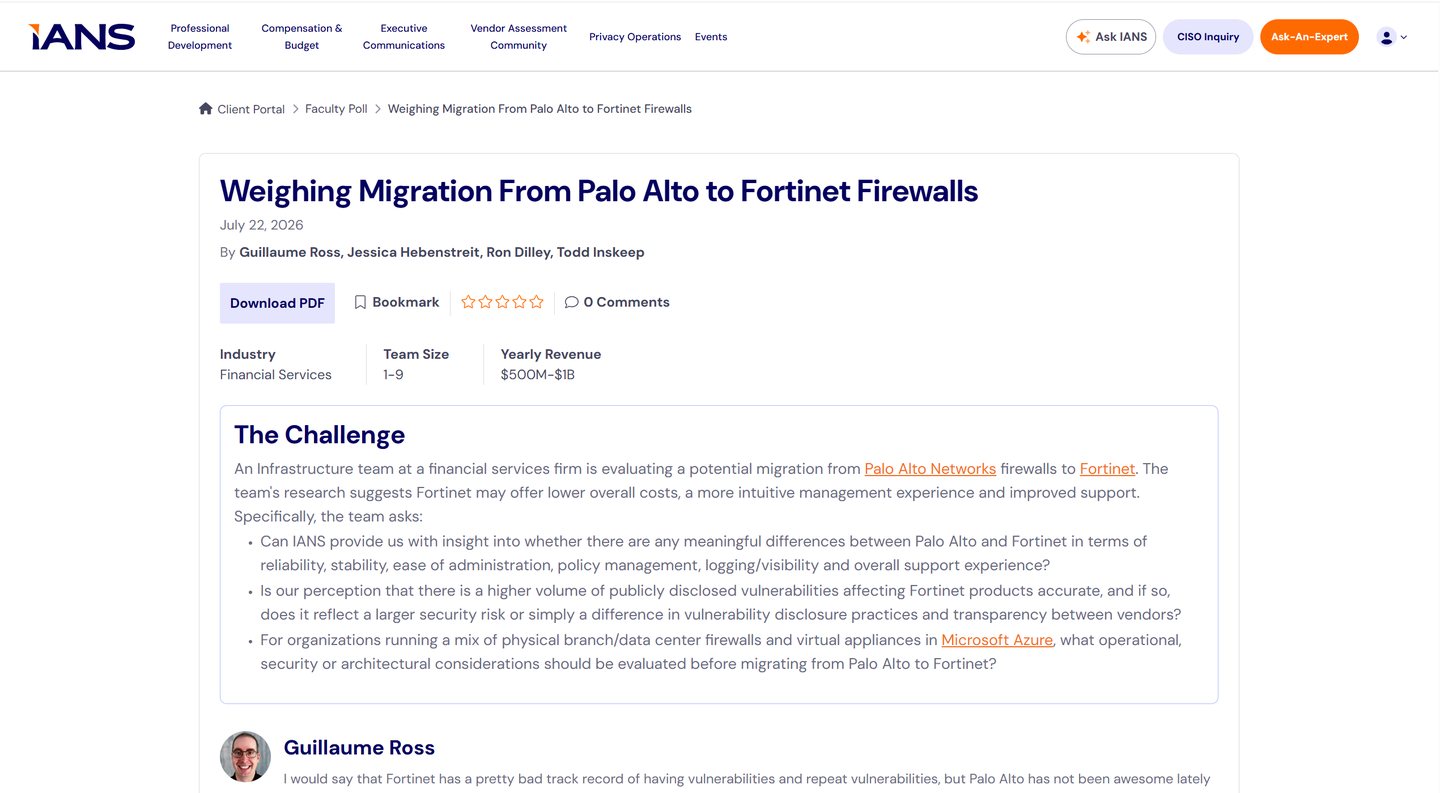
A Faculty Poll is a question a client brings to IANS that several faculty experts answer. Publishing one used to mean moving it manually between Salesforce, the CMS and the search index. I built a daily job that picks each poll up once the answers are confirmed, assembles the content and the downloadable document, and pushes it live.
Same stack as the rest of my work here: C# endpoints for the Salesforce connection and the Sitefinity content, a Node.js endpoint for Elasticsearch indexing, React and JavaScript for the published page above.
Turned a content library into a path people follow — and come back to.
The material already existed — on-demand sessions, video insights, learning pathways — but it sat there as a catalogue. I built the layer that turns it into progress: an active roadmap with live completion, the pathways and sessions inside it checking off as they're finished, the other roadmaps available with progress on each, a goal tracker, and badges and certification that accumulate as people work through it. The content team got the tools to organize the tracks themselves.
Completion is tracked against the content itself, not the route someone took to reach it. Wherever a person finishes a session, their roadmap knows. It would have been far simpler to only count activity inside the dashboard — and it would have quietly lied to users.
Relaunched a full product section and rebuilt its operational framework into something people use again.
Two pieces shipped together. First, a homepage for the Privacy Operations section that surfaces everything in it — framework guides, cheat sheets, slides, toolkits, briefings — grouped so you can see what exists instead of having to search for it, with the content team owning what appears and in what order.
Second, the framework itself: nine domains, each holding a set of principles. I built and rebuilt the main framework page, the navigation between domains, and the detail page for every individual principle — downloads, ratings and comment threads included — plus a ready-to-use workbook covering all domains and principles. Structure was the whole point: the previous framework had fallen to a fraction of its former use, and reviving it meant giving people something they could work through one principle at a time.
Section consumption had been sliding for roughly a year. The relaunch doubled it against the pre-launch months and reversed the trend, with framework activity up an estimated 83% year over year.
Gave the product a front door. Before this, users landed on a search box.
The portal's entry point was a search page — you arrived and you searched. I built a landing page in its place: one surface that shows the different products the company offers, with articles streaming in live and the content team able to update text, thumbnails and ordering themselves.
One of my first projects here, built before AI assistance existed. The page has evolved since — the architecture I chose has held.
Total portal traffic rose 25–30% year over year across the period. Other work shipped in the same window, so I separated out its contribution and quote only what the homepage itself earned.
All of these are from 2021, straight out of my bootcamp — my first months writing JavaScript. Everything I've built since lives in private company codebases, which is why my public GitHub stops here. I keep these up because the distance between them and the work above is the part I'm proud of.
More at github.com/danielacayuela
Grouped by how much I actually work in each.
C#/.NET: extending established codebases — endpoints, integrations, scheduled jobs.
Open to Full Stack, Frontend and AI engineering roles — and to work where software supports the commercial side of the business. Remote-friendly, and used to it.